
Sustainability is derived fom the Latin word sustinere i.e., to hold and sustain. Sustain is to maintain. It is related to the quality of life in a comunity – whether the economic, social and environmental systems that make up the comunity are providing a healthy, productive, meaningful life for all comunity residents, present and future.
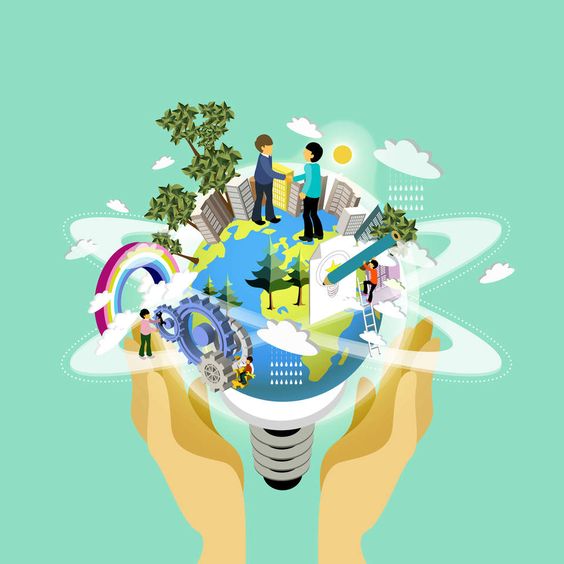
Sustainability can defined as the practice of maintaining processes of productivity ( natural or human made ) indefinitely by replacing resources used with resources of equal or greater value without degrading or endangering natural biotic systems.
Sustainability development:-
The concept of sustaniable development has two related concepts, i.e.,the right to develop and the need to sustain the environment, which need to be balanced for achieving future development in a sustainable manner . It is the practice of developing land and construction projects in a manner that reduces their impact on the environment by creating energy efficent models.
This can take the form of installing solar panels or wind generators on factory sites, using Geothermal heating techniques or even participating in cap and trade agreements. The biggest criticism of sustainable development is that it does not do enough to conserve the environment in the present and is based on the belief that the harm done in one area of the world can be counter balanced by creating environmental protections in the other. According to Brundtland Commission in its 1987 report ”OUR COMMON FUTURE ”.
”Sustainability development is development that meets the need of the present , without compromising the ability of future generations to meet their own needs.”
Sustainability development has three goals:-
- To minimize the depletion of natural resources,
- To promote development without causing harm to the environment and to make use of environmentally friendly practices.
This implies that we need to look after our planet, our resources and our people to ensure that we can live in a sustainable manner and that we can regenrate, maintain and improve planetary resources for use by future generations. Sustainable development is the organizing principle for sustaining finite resources necessary to provide for the needs of future generations of life on the planet. It is a process that predicts a desirable future state for human societies in which living conditions and the ”integrity , stability and beuty” of natural biotic system.
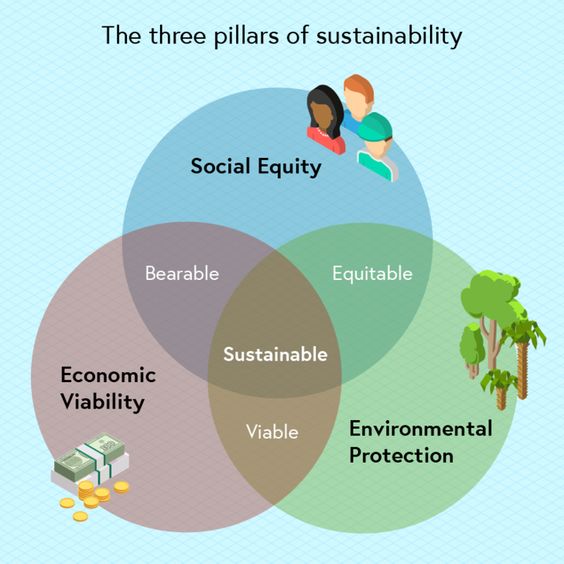
Four dimensions of the sustainability are economic , ecological, political and cultural sustainability . The first three domains were endorsed by the UNITED NATIONS MILLENNIUM DECLERATION i.e., economic, environment and social sustainability. so to achieve true sustainability factors we need to balance economic , social and environmental sustaiability factors in equal harmony .
These may be defined as :-
Environmental Sustainability:- The environment supports our life system . The human behaviour impacts the environment and we either nurture or mistreat it. Mahatma Gandhi stated ,”Earth provides enough to satisfy every man’s need but not every man’s greed”. The harsh fact is that humans continue to consume natural resources at a destructive pace.
Environmental sustainability means that we are living within the means of our natural resources . To live in true environmental sustainability we need to ensure that we are consuming our natural resources, such as materials, energy fuels, land, water etc., at a sustainable rate. Presntly, the exhaustible resources are over utilized rapidly. The speed of exploitation of renewable resources is faster than their regenerative capacity. This results in problem for presnt as well as future generations.
Technology can be used to replace non-renewable or exhaustible energy resources by the enhance resources. Moreover, non -renewable energy should be depleted at slower pace enabling transition to renewable energy resources. Development should be synonymous with environmental protection and sustainable use of natural resources. Environmental sustainability should not be consumed with full sustainability, which also needs to balance economic and social factors.
A view of cimmunity as three separate, unrelated parts:- an economic part , a social part and an environmental part.
The environmental policies have a deep effect on the development process while the development process damages the whole environment system. Factors like, urbanization , industrialisation, population growth, poverty etc. increses the demand of resources resulting in resource depletion. There are dangerous effects of mndless development like,effect of gases on ozone layer, greenhouse effects , global warming, decrease in forest cover , water and land pollution , effects of burning of fossil fuel etc.
Environmental Sustainability and sustainable development are one and teh same; there is quite a few ways in which they differ in their goals. They have the same overall goal that of conserving natural resources etc. but their priorities of actions are different. In a way, ”Sustainable development is the pathway to sustainability”.
For instance, there will be disagreements when it comes to developing construction practices on a wetland. The environmental sustainability focus would argue that the preservation of the wetland is more important than everything else. Sustainable development will show that by incorporating preservation areas, and contributing to the overall preservation of a different wetland area that the damage is balanced out. Sustainable development will also argue that the local economic benefits will lead to more funding to create environmental protection areas elsewhere.
Economic sustainability:- Economic sustainability requires that a business or country uses its resources efficiently and responsibly so that it can operate in a sustainable manner to consitantly produce an operational profit. Without an operational profit a business cannot sustain itsactivities. Without acting responsibly and using its reources effiently a company will not be able to sustain its activities in the long term. An economical sustainable system must also be able to produe goods and services on a continuing basis, to maintain manageable levels of government and external debt, and to avoid extreme sectoral imbalances which damage agricultural or industrial produdction.
Social sustainability:- A socially sustainable system must achieve fairness in distribution and opportunity, adequate provision of social services inluding health and education , gender equity, and political accountability and participation. Social sustainability is the ability of society, or any social system, to persistently achieve agood social well-being. Achieving social sustainability ensures that the social well-being of a country, an organisation, or a community can be maintained in the long term.
Taking these three pillers of sustainability further if we only achieve two out of three pillers then we end up with:-
social + Economic Sustainabilty = EQUITABLE
Social + Environmental Sustainability = BEARABLE
Economic + Environmental Sustainability = VIABLE
Only through balancing economic + social + environmental can we achieve true sustainability and a truely circular economy.
Resolving these differences can be difficult. Very often, money and economy will prove to be the deciding factor. This doesn’t mean that one side loses and one side wins, but the environmental factors can influence the development design to create an approach that provides the best of both worlds, without completing adopting one approach over the other.
Essential conditions for achieving Sustainable Development:-
The essential requirements of facilitating overall sustainable development are:-
a. The human needs should not be beyond the capacity of environment to supportit Reduce poverty and ensure equality of opportunity and equitable distribution of assets. Invest in health and education.
b. Participation of indigenious communities , women, tribes etc. in development process.
c. Effective waste management and pollution control and access to clean energy produced in a sustainable manner. Preserve marine life from ill effects of pollution and climate change. Resilience to natural disasters and control use of hazardous materials.
Symptoms of Usustainability:-
The symptoms of unsustainablity are:-
a. Ecological Symptoms:- depletion of ozone layer, global warming, acid rain, extinction of species and declining forest cover etc.
b. Eonomic symptoms:- economic tension, intra-generational and inter-generational inequalities.
c. Social symptoms:- wars and social disturbances resulting iin mass destruction.
Causes of Unsustainabilty
The causes of unsustainability are:-
a. Population explosion and discrepancy in population and distribution of natural reources.
b. Higher per capita environmental demand and excessive demand of natural resources like oil, coal, wood,etc. and reduction in biodiversity.
Indicators of SUSTAINABILITY
The indicators of sustainability are mentioned below:-
a. GDP Growth:- Higher total production growth rate facilitates employment, price stability and material welfare. An indicator of sustainability, it helps in eliminating poverty .

b. Population instability and Water Availability:- Over population leads to over-exploitation of resources and is a hindrance in sustainability. Availability of sufficient water for consumption, industrial and agricultural use is to be ensured .
c. Clean Air Index and Energy Resources:- Pure and clean air is essential for survival of human beings and other species. Air Pollution, acid rain and greenhouse effects are threats for sustainability. To achieve long-term sustainability use of renewable sources must be lower than it’s rate of regeneration.
d. Human Resource Development:- It incorporates health care, nutritional standards, standard of living and education as indicators emphasized by the World Bank and UNDP .